Rumination
This lesson will review the concept of rumination. Why do we ruminate, how can we identify it, and how can we reduce it?
What is Rumination?
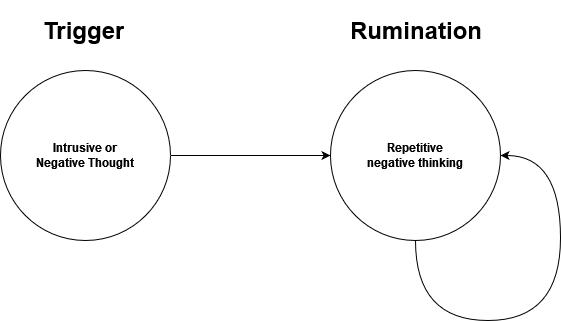
Rumination is when we engage in a repetitive negative thought process. Rumination is a repetitive act driven by fear - for example imagining something bad happening, replaying a past event, or trying to plan for worst case scenarios. It's like having a song stuck in your head, but instead of a song, it is an intrusive thought that seems like it just won't go away.
Rumination can often feel uncontrollable and overwhelming. However, notice in the first sentence of this lesson rumination is defined as an action we take. Rumination is not something that happens to us, but an act we initiate and maintain.
Why do we ruminate?
It is natural to plan, to be prepared, and to learn from past events. This is called problem solving, and can feel very similar to rumination. We can think of rumination as problem solving but corrupted by our contamination OCD into a relentless negative cycle. With rumination, there is no problem solving happening, even though that is often the motivation for engaging in rumination.
Key Concepts
Research shows us that rumination can be reduced or stopped completely. It takes practice, and knowledge of the following key concepts:
- OCD has two key parts - obsessions and compulsions.
- Obsessions are uncontrollable thoughts and fears that lead to compulsions.
- Compulsions are behaviors we engage in.
- Rumination may seem like an obsession, but it is actually an act of compulsion, triggered by an initial negative or intrusive thought.
- Just like the avoidance cycle, we must look for where we have control in the cycle - here, we have control over the compulsion, not the obsession.
- Remember, contamination OCD has ironic solutions - the thing we avoid is often what we need to do to break the cycle and reduce the trigger in the first place.
We have established that rumination is in our control, and we need to reduce it to break the cycle. Next, we will review how we identify and stop rumination.
How to Identify Rumination
It can be challenging to identify rumination. It happens in our thoughts, and we might not show any outward observable behaviors. Some tips for identifying rumination:
- We all have intrusive thoughts that pop up - we have no control over this. Rumination will stick around longer than a thought that pops up.
- Problem solving leads somewhere and ends. Rumination will repeat. If you find yourself thinking the same thing over and over, it's likely rumination and not problem solving.
- Rumination is focused on negative thoughts, what will and did go wrong - where problem solving is focused on finding positive outcomes.
It might take practice to catch yourself ruminating. Try asking yourself some questions - 'Am I problem solving or ruminating?'. 'When is the last time I ruminated, and what did it feel like?'
How to Stop Rumination
Rumination is a behavior and it can be stopped - we will take the same approach we use to break the avoidance cycle to break rumination, we will face it head on. We will not distract ourselves from rumination, or try to ignore it. We will attack it. Let's explore some approaches for stopping rumination.
Open Palm Method
Imagine that your brain is an open palm. It might help to close your eyes and visualize an open palm, or, physically open your palm in front of you.
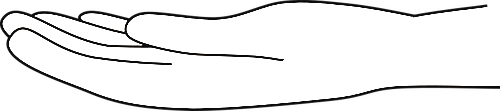
Thoughts drift through the air, and they might land on your open palm. That is okay, we don't control the thoughts in the air, where or when they land.
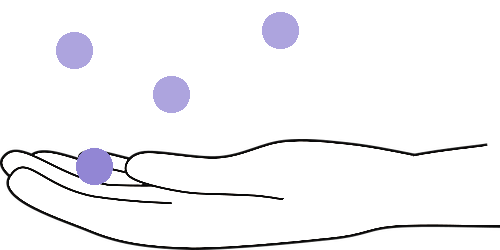
When a thought lands on our palm we have a choice - do we squeeze the thought? Do we engage with it, repeat it, plan around it and imagine it in more detail? Or, do we leave our palm open, accepting that the thought is here and at some point it will drift away just the same as it came to us in the first place?
Let's practice. Imagine now a thought landing on your palm - let's say it's the thought of your favorite place in the world. Squeeze the thought. Imagine the palm closing into a fist, or physically squeeze your open hand. Give the thought your attention. Then, release your hand back into an open palm. Don't force the thought away, we are not throwing anything away. The thought might linger on our palm, it might float away. It might come back later again - if the thought comes back we can say 'Hey, there is that thought again' but we leave our palm open.
We acknowledge thoughts that land in the palm of our mind, but we don't close our fist around them. Next time you have an intrusive thought, imagine the palm in your mind and practice keeping it open. Remember that we don't control when or where thoughts land, and they may even come back more than we like, but by leaving our palm open, the thought has a chance to leave. If we close to a fist, the thought cannot leave.
Engage
Another technique for reducing rumination is to engage with the thought. Often times, rumination is a form of avoidance. Engaging with the thought can take its power away. Ask yourself
- What about this thought is making me uncomfortable?
- How does this make sense? Was this a random thought that landed with me, or was there a trigger?
- Is this an opportunity to face my fear and practice discomfort?
Try telling yourself, maybe even say this out loud - 'I am ruminating right now. I am accepting this thought, it might be uncomfortable, but I won't engage. The thought will come and go.'
Practice
Like exposure and the avoidance cycle, it takes practice to identify and stop rumination. As you complete exercises in MyOCD, watch for rumination, practice letting thoughts come and go, and practice acknowledging them but not engaging with them.