The Ironic Process Theory
In this lesson, learn about the Ironic Process Theory which describes how intentionally trying to avoid a thought or feeling can ironically make that thought or feeling more likely to occur.
Two Processes
Dr. Wegner was a social psychologist who described the Ironic Process Theory. You may have already heard of this famous theory in the classic example 'Don't think of a Pink Elephant', which often has the opposite effect causing us to think about the pink elephant. To explain this effect, Dr. Wegner described the existence of two processes.
1. The intentional operating process. This process is conscious, requires effort to engage in, and can be stopped.
2. The ironic monitoring process which is unconscious and uninterruptible.
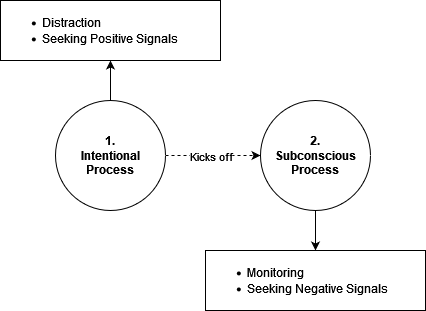
Dr. Wegner described that the first process is searching/creating positive signs of a desired behavior, while the second process is constantly searching/creating negative signs. When told not to think of a pink elephant, we use the intentional operating process to search for distractions and confirm - 'I am thinking about something else'. Meanwhile, the ironic monitoring process is searching for any signs of a pink elephant, and in doing so, causes us to think of it.
Impact
By purposefully seeking positive signals, or engaging in avoidance like thinking of distractions, the secondary process can be overridden but only temporarily. When tired or distracted, the first process is not active, and the second process emerges. So by trying to suppress a thought, we train our brain to raise it as soon as we are not actively suppressing it.
The secondary process causes discomfort (negative signals) and the apparent solution (active suppression) is actually ironically building up the cycle.
Breaking the Ironic Process
The ironic process requires a non-intuitive solution which is to limit the first process of intentional seeking. At first, this will cause the second process to 'win' and uncomfortable thoughts or feelings will come. Just like the avoidance cycle, by facing the discomfort the brain can unlearn this faulty connection. Research shows, that by accepting and facing uncomfortable thoughts, instead of avoiding or distracting from them, their frequency and severity can be decreased.
Ironic Process Theory and Contamination OCD
Ironic Process Theory may apply to your contamination OCD. For example, someone with contamination OCD might distract themselves from thoughts by actively thinking of something else (thought suppression), or, scan for signs of illness (monitoring). These active processes are strengthening the background process that is constantly scanning for negative signals, and as soon as we stop the active suppression, the second process will win. In times of high stress, or when tired, active suppression is no longer possible due to mental fatigue.
Similar to breaking the avoidance cycle, we have to look for what part of the Iron Process Theory we have control over. The first process is conscious, while the second is subconscious.
Dr. Wegner proposes breaking the ironic process by stopping the intentional part. This takes practice to stop, and at first the secondary process will become more prominent. But over time, stopping active suppression and avoidance will unlearn the secondary process. In your contamination OCD journey, you may notice yourself using distractions to avoid facing thoughts of being sick, or, be constantly scanning and monitoring yourself or surroundings. Practice stopping these behaviors just as you practice sitting in discomfort, and like the avoidance cycle, the ironic process will lose its power over time.